|
Friday July 08, 2005___ 12:52
P.M. C. S. T.
By Kenneth Martin
NASA Satellites Measure and
Monitor Sea Level
July 07, 2005
For the first time, NASA has the tools and
expertise to understand the rate at which sea level
is changing, some of the mechanisms that drive those
changes and the effects that sea level change may
have worldwide.
"It's estimated that more than 100 million lives are
potentially impacted by a one-meter (3.3-foot)
increase in sea level," said Dr. Waleed Abdalati,
head of the Cryospheric Sciences Branch at NASA's
Goddard Space Flight Center, Greenbelt, Md. "When
you consider this information, the importance of
learning how and why these changes are occurring
becomes clear," he added.
Although scientists have directly measured sea level
since the early part of the 20th century, it was not
known how many of the observed changes in sea level
were real and how many were related to upward or
downward movement of the land. Now satellites have
changed that by providing a reference by which
changes in ocean height can be determined regardless
of what the nearby land is doing. With new satellite
measurements, scientists are able to better predict
the rate at which sea level is rising and the cause
of that rise.
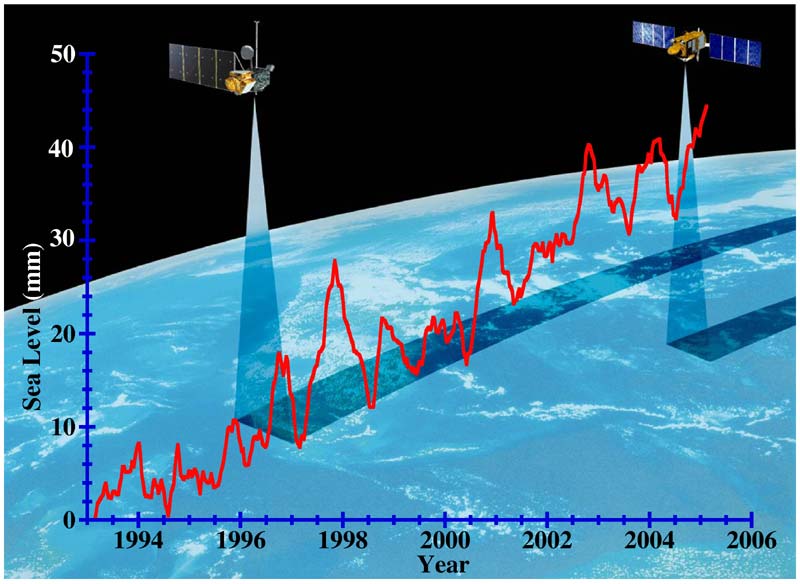
"In the last 50 years sea level has risen at an
estimated rate of .18 centimeters (.07 inches) per
year, but in the last 12 years that rate appears to
be .3 centimeters (.12 inches) per year. Roughly
half of that is attributed to the expansion of ocean
water as it has increased in temperature, with the
rest coming from other sources," said Dr. Steve
Nerem, associate professor, Colorado Center for
Astrodynamics Research, University of Colorado,
Boulder.
Another source of sea level rise is the increase in
ice melting. Evidence shows that sea levels rise and
fall as ice on land grows and shrinks. With the new
measurements now available, it's possible to
determine the rate at which ice is growing and
shrinking.
"We've found the largest likely factor for sea level
rise is changes in the amount of ice that covers the
Earth. Three-fourths of the planet's freshwater is
stored in glaciers and ice sheets or the equivalent
of about 67 meters (220 feet) of sea level," said
Dr. Eric Rignot, principal scientist for the Radar
Science and Engineering Section at NASA's Jet
Propulsion Laboratory, Pasadena, Calif. "Ice cover
is shrinking much faster than we thought, with over
half of recent sea level rise due to the melting of
ice from Greenland, West Antarctica's Amundsen Sea
and mountain glaciers," he said.
Additionally, NASA scientists and partner
researchers now are able to measure and monitor the
world's waters globally in a sustained and
comprehensive way using a combination of satellite
observations and sensors in the ocean. By
integrating the newly available satellite and
surface data, scientists are better able to
determine the causes and significance of current sea
level changes.
"Now the challenge is to develop an even deeper
understanding of what is responsible for sea level
rise and to monitor for possible future changes.
That's where NASA's satellites come in, with global
coverage and ability to examine the many factors
involved," said Dr. Laury Miller, chief of the
National Oceanic and Atmospheric Administration
Laboratory for Satellite Altimetry, Washington, D.C.
NASA works with agency partners such as the National
Oceanic and Atmospheric Administration and the
National Science Foundation to explore and
understand sea level change. Critical resources that
NASA brings to bear on this issue include such
satellites as:
-- Topex/Poseidon and Jason, the U.S. portions of
which are managed by JPL, which use radar to map the
precise features of the oceans' surface, measuring
ocean height and monitoring ocean circulation;
-- Ice, Cloud and Land Elevation Satellite (IceSat),
which studies the mass of polar ice sheets and their
contributions to global sea level change;
-- Gravity Recovery And Climate Experiment (Grace),
also managed by JPL, which maps Earth's
gravitational field, allowing us to better
understand movement of water throughout the Earth.
For more information about sea level change on the
Internet, visit: http://www.nasa.gov/vision/earth/environment/sealevel_scienceupdate.html
.
For information about Topex/Poseidon and Jason on
the Internet, visit: http://sealevel.jpl.nasa.gov/ .
For information about Grace on the Internet, visit:
http://www.csr.utexas.edu/grace/ .
For information about NASA and agency programs on
the Internet, visit: http://www.nasa.gov/home/index.html
.
JPL is managed for NASA by the California Institute
of Technology in Pasadena
Alan Buis (818) 354-0474
Jet Propulsion Laboratory, Pasadena, Calif.
Dolores Beasley/Marta Metelko (202) 358-1753/1642
NASA Headquarters, Washington, D.C.
2005-111
|