WGNNews.org Posted 7:55 P.M. May 23, 2005
By Kenneth Martin
Roadmap To Peace
Meeting of Quartet
MFA Guesthouse "Osobnyak"
Moscow, Russia
May 9, 2005
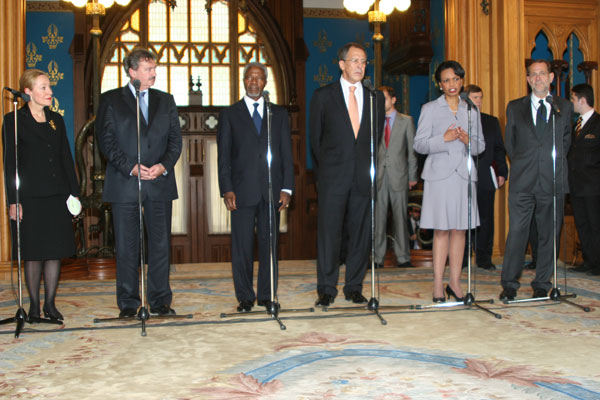
During her
travel
to Russia with the President, Secretary Rice and members of the
Quartet for Middle East Peace held a
press
conference after their meeting. From L to R: Benita
Ferrero-Waldner, EU Commission Member for External Relations;
Jean Asselborn, Minister for Foreign Affairs and Immigration of
Luxembourg; Kofi Annan, Secretary General, United Nations;
Sergey Lavrov, Foreign Minister, Russian Federation; Secretary
Rice and Javier Solana, High Representative for Common Foreign
and Security Policy, European Union. State
Department photo.
Released on May 9, 2005
********
Press Statement
Tom Casey, Acting
Spokesperson
Moscow, Russia
May 9, 2005
Quartet Statement
Following is the text of the Quartet
Statement:
BEGIN TEXT:
The Quartet met today in Moscow. The Quartet
emphasizes that this is a hopeful and promising moment for both
Palestinians and Israelis, and that they deserve the full
support of the international community in helping them with the
hard work and difficult decisions required in order to make
positive use of this opportunity. The Quartet welcomed the
commitments of the parties at the Sharm el-Sheikh summit of
February 8 and urged them to renew their efforts to fulfill the
commitments they agreed to at that time, in order to maintain
momentum at this fragile moment of opportunity. The Quartet,
underscoring the urgency of the matter, affirms its commitment
to fully support the efforts of both parties to ensure
successful Israeli withdrawal from Gaza and parts of the
northern West Bank.
The Quartet strongly reiterated its commitment
to the two-state solution, and to Israeli withdrawal as a way to
re-energize the Roadmap. The Quartet stresses the importance of
full and complete Israeli withdrawal from Gaza in a manner
consistent with the Roadmap as an important step paving the way
toward realizing the vision of two democratic states, Israel and
Palestine, living side by side in peace and security. The
Quartet affirms that a new Palestinian state must be truly
viable, with contiguity in the West Bank; reminds all concerned
that a state of scattered territories will not work; and
emphasizes that no party should take unilateral actions that
prejudge final status issues. The Quartet also affirms that the
two-state vision and the Roadmap are the best means of achieving
a settlement negotiated between the two parties, leading to a
permanent peace and an end to the occupation that began in 1967.
With respect to this, the Quartet observes that the Roadmap has
been endorsed by Israel and the Palestinian Authority and
remains the objective of the international community; and urges
both parties to take steps to fulfill all their obligations
under the Roadmap.
The Quartet expresses its full support for its
Special Envoy for Gaza Disengagement, James Wolfensohn. His
mandate is to focus on the non-security aspects of withdrawal,
particularly disposition of assets; passages, access and trade;
and revival of the Palestinian economy during and after Israeli
withdrawal. This will require close coordination with both
Israel and the Palestinians to identify and implement those
actions and policies that will ensure a smooth and successful
implementation of the Israeli initiative. On the Palestinian
side, this includes above all a strong commitment to security
reform and performance; and the building of transparent,
accountable government institutions and an investor-friendly
climate, with a view to restoring growth. On the Israeli side,
this involves relieving the economic hardships faced by the
Palestinian people and facilitating rehabilitation and
reconstruction by easing the system of restrictions on the
movement of Palestinian people and goods and taking further
steps to respect the dignity of the Palestinian people and
improve their quality of life -without endangering Israeli
security -and taking into consideration the World Bank report of
December 2004. At the London meeting on March 1, the
international community underscored its readiness to play a
vital role by providing financial support to the Palestinians at
this critical moment. Creating the environment conducive for a
long-term, sustainable and viable economic development of all
the Palestinian territories would constitute a suitable basis
for additional assistance efforts by the international
community.
The Quartet emphasizes Mr. Wolfensohn's
mandate to promote direct dialogue and cooperation between
Palestinians and Israelis on these economic issues, to ensure a
smooth transition in Gaza and parts of the northern West Bank.
In this context, the Quartet stresses the urgent need for
Israelis and Palestinians to coordinate directly and fully on
withdrawal preparations.
The Quartet recognizes that economic
development and progress on security go hand in hand as security
reforms and the reestablishment of the rule of law are necessary
to create an enabling environment for economic growth and
political progress. The Quartet also recognizes the need for
continued efforts by the international community to assist the
PA in accomplishing these tasks, including rebuilding the
capabilities of the Palestinian security services. Ongoing
assistance by the international community, in particular members
of the Quartet and countries of the region, constitutes a
significant contribution to these efforts. The Quartet calls
upon Israel and the Palestinian Authority to facilitate these
efforts.
In that regard, the Quartet expresses its full
support for General William Ward, U.S. Security Coordinator, to
assist the Palestinians in reforming and restructuring their
security forces, and to coordinate international assistance
towards those efforts. The Quartet welcomes the recent concrete
steps that President M. Abbas has taken towards reform of the
Palestinian security services, and stresses the need to continue
implementation of these reforms in order to permanently
reinstate law and order in Gaza and the West Bank.
The Quartet commends the Palestinian people's
and leadership's commitment to democracy and attaches great
importance to a successful continuation of the democratic
process. The latest round of municipal elections has just been
conducted. The Quartet commends the Government of Israel for
facilitating the operations. The holding of free, fair, and
transparent multi-party legislative elections in the West Bank,
Gaza and East Jerusalem, under the scrutiny of international
observers, will be another vital step forward on the path
towards building a reformed and accountable Palestinian
Authority. As additional voter registration for these elections
has just begun, the Quartet calls on both the PA and Israel to
urgently take all necessary steps, including freedom of movement
for candidates and voters, to achieve this goal and renews its
offers of technical support and providing election observation
services.
The Quartet deems it necessary to ensure
continued efforts aimed at full implementation of the Roadmap
following Israeli withdrawal from Gaza and parts of the northern
West Bank.
The Quartet reiterates its commitment to the
principles outlined in its previous statements, including those
of March 1, 2005 and May 4, 2004; and reaffirms its commitment
to a just, comprehensive, and lasting settlement to the
Arab-Israeli conflict based upon resolutions 242 and 338, and
will remain engaged with all parties to help ensure that
progress towards this goal is achieved.
END TEXT.
2005/487
Released on May 9, 2005
********
Remarks With Russian Foreign Minister Sergey Lavrov, United
Nations Secretary General Kofi Annan, and European Union
President Jean Asselborn After Their Quartet Meeting
Secretary Condoleezza
Rice
Moscow, Russia
May 9, 2005
SECRETARY GENERAL ANNAN: Good afternoon, ladies and
gentlemen. As you know, we've just completed a meeting of the
Middle East Quartet in which we covered a lot of important
ground, as you will see later from the
statement or the communiqué we will be issuing.
We emphasized that this is a hopeful and promising moment for
both Palestinians and Israelis. They both deserve the full
support of the international community and we reaffirm our
support for the Israeli initiative to withdraw from Gaza and
parts of the northern West Bank.
We strongly reiterate our commitment to the two-state
solution, and to Israeli withdrawal from Gaza and parts of the
northern West Bank as a way of re-energizing the roadmap. We
stress the importance of full and complete Israeli withdrawal
from Gaza as an important step paving the way towards realizing
the vision of two democratic states, Israel and Palestine,
living side by side in peace and security.
A new Palestinian state must be truly viable, with contiguity
in the West Bank. No party should take unilateral action that
will prejudge the final status issues.
The Quartet urges both parties to take steps to fulfill their
obligations under the roadmap.
We express our full support for our Special Envoy for Gaza
Disengagement, Mr. James Wolfensohn. There is also an urgent
need for the Israelis and Palestinians to coordinate directly
and fully on withdrawal preparations. This will require close
coordination with both Israel and the Palestinians to identify
and implement those actions and policies that will ensure smooth
and successful withdrawal. Creating the environment conducive
for a long-term sustainable and viable economic development of
all the Palestinian territories would constitute a suitable
basis for additional assistance efforts by the international
community.
The Quartet recognizes that economic development and progress
on security go hand in hand. Security reforms and the
reestablishment of rule of law are necessary to create an
enabling environment for economic growth and political progress.
We also recognize the need for additional efforts by the
international community to assist the Palestinian Authority in
accomplishing these tasks, including by rebuilding the
capabilities of the Palestinian security services.
In that regard, we welcome the recent concrete steps that
President Abbas has taken towards reform of the Palestinian
security services, and stress the need to continue
implementation of these reforms.
We commend the Palestinian Authority's commitment to
democracy and look forward to the holding of free, fair and
transparent multiparty legislative elections in the West Bank,
Gaza and East Jerusalem under the scrutiny of international
observers.
We also took advantage of today's meeting to introduce Alvaro
de Soto, my new Envoy to the Quartet and also welcome Mr. David
Welch, the new U.S. Envoy to the Quartet.
Finally, the Quartet reaffirms its commitment to a just,
comprehensive and lasting settlement to the Arab-Israeli
conflict based on Resolutions 242 and 338, and will remain
engaged with all the parties to that end.
We will take your questions.
QUESTION: Could you discuss the Russian proposal about
the international meeting which Putin made in Cairo? And what
are the results of your discussions? Thank you.
FOREIGN MINISTER LAVROV: (Via interpreter) On the
whole, we agreed that the Quartet should remain in permanent
contact with the Quartet and with each other. We all agreed, as
it was reflected in our communiqué, that our final goal lies in
a comprehensive and just settlement for the Arab-Israeli
conflict.
And the proposal by President Putin about thinking of the
future means we need not only to concentrate on the immediate
tasks of the Palestinian-Israeli settlement but to regard this
process as a whole and to think about the future. This also
includes our thinking about the multilateral aspects of the
international settlement. We agreed to pursue our exchange of
opinions in this regard. All the members of the Quartet believe
that this is a very important aspect.
MODERATOR: Other questions, please.
QUESTION: Diane Sekirkan (ph), Associated Press. The
question for the Secretary of State, please.
There had been a few basic steps that needed to take place in
order for the roadmap to get underway. You know, the release of
prisoners by the Israelis, the disarming of militants by the
Palestinians. You know, what's going to happen to the roadmap
when you can't even get these basic steps underway?
Thank you.
SECRETARY RICE: Well, first of all, we are all in
agreement that this is a time when we must seize the opportunity
before us, an opportunity that is presented by the Palestinian
elections and the new Palestinian Authority and the coming
Israeli withdrawal from the Gaza and four northern territories
of the West Bank.
We also believe that the parties should intensify their
efforts to fulfill their Sharm el-Sheikh agreements. But I would
just caution, this process will have its ups and downs over the
next several months. The obligation of the international
community, represented here by the Quartet, is to help the
parties to move through these difficult issues to make
achievements so that we can complete the Israeli withdrawal from
the Gaza and the four settlements in a way that accelerates our
ability to make progress on the roadmap.
And so, for instance, we had a report today on General Ward's
efforts with the Palestinians and on behalf of the international
community on security reform with the Palestinians, which I
think will contribute to this effort.
So we will intensify our efforts and we expect the parties to
intensify their efforts as well.
QUESTION: My question is addressed to Secretary of
State and to Secretary General, Mr. Annan. How can you assess
the Arab initiative under the roadmap because this initiative
proposes the peace not only to Palestinians and Israelis, but
rather to Arabs and Israelis?
SECRETARY ANNAN: I think when you see the communiqué
that we are not limiting our efforts. We are focusing on the
Israeli-Palestinian issue, but we do indicate the ultimate
objective is to see settlement in the region based on UN
Resolutions 242 and 338. And, of course, we are also very
conscious of the Arab initiative which was put forward in
Beirut, and I think that's what you are referring to, which is
still part of the basis on which we are going forward. In fact,
when you look at the UN situation and the Arab initiative, in
effect, there's change in land-for-peace and showing that the
whole region is not only at peace and security, but that they
move on to have normal, neighborly relationship.
In this broader context, the initiative put forward by the
Crown Prince of Saudi Arabia in the Beirut summit was an
important contribution and we bear that in mind as we move
forward.
SECRETARY RICE: Let me just underscore that I think
that we all believe that the roadmap does incorporate many of
these ideas and we are devoted to moving forward on the roadmap.
And obviously, the true goals here is to have two states --
Israel and the Palestinian state -- living side by side in peace
and democracy, but in a region that is also at peace.
But let me just emphasize that many opportunities have been
missed in the Middle East and we have a real opportunity before
us in the next several months to have a successful disengagement
of Israel from the Gaza and the four West Bank territories. We
then have a very strong possibility of the establishment of
democratic, transparent institutions that can be the basis of a
Palestinian state; of economic development in this region that
can improve the lives and the hopes of the Palestinian peoples;
and what you hear here is a commitment not to miss the
opportunity that is just in front of our very eyes.
And so when we talk about this next four or five months, it
is not because we do not have a bigger vision; it is because we
recognize that we have to seize the opportunity that is right
before us if we are to build confidence and trust to move
forward.
PRESIDENT ASSELBORN: We know that, in the
international community, Europe is between Russia and the United
States. But Kofi Annan seems (inaudible) that Europe has a
voice.
So just two sentences from our side and they can say. First,
we want that withdrawal from Gaza becomes a success. Second, we
want also, and we have to work and we have to help the
Palestinians, that the elections, parliamentarian elections, now
in June or in July, will be a success. That's a short time, two
very important aims.
Then, we are in the transitional period. In this region, we
have to have to change mentalities. That's very, very important.
We have to help that hate disappears between both populations.
And I think that on the Israeli sides, a lot of positive things
happened already. But it will be also an after or post
withdrawal Gaza period. And there, what Condoleezza Rice said
and what Kofi Annan said to go forward, to have a perspective,
is very, very important.
And on the other side, the Palestinian side, a lot of
positive things happened also to increase security and so on.
And there, they have to do everything -- everything -- and we
have to encourage them to -- oh sorry. (Laughter.)
[Interpreter translates into Russian.]
So I think that on the Palestinian side -- that's my last
sentence -- a lot of positive things happened also. But also
here they have to make more efforts -- more efforts to really --
to destruct all the nets of violence. And I think in the
European Union, I just want to mention it, we, every year, give
250 million Euros to the Palestinians, that is, on the
Commission side, my colleague, Benita Ferrero-Waldner and all
the other member states also help -- to help really the
Palestinian Authority and in the Quartet. That's a very, very
important organization. We have to bring a lot of solidarity,
international solidarity on the table, to put and to pull on the
-- in the same way.
So thank you very much.
FOREIGN MINISTER LAVROV: (Via Interpreter) In
conclusion, I would like to thank all my colleagues for holding
this meeting in Moscow.
It's very symbolic that this meeting takes place in the
victory date -- in the date when we mark the 60th anniversary of
our victory in the World War II.
At that time we united our effort to combat our common enemy
and today we need also to unite our efforts to fight a new
enemy, primarily it's international terrorism.
The Arab world-Israeli conflict is the holdover of the past
which we have now. And this conflict nurtures extremism and, in
some parts, terrorist acts which occur in the region.
It's only together -- it's only through our combined efforts
-- that we can achieve the settlement in the region, both
through the Quartet as well. And I hope, as my colleague
Condoleezza Rice mentioned, this chance which we'll have this
year won't be missed.
Thank you very much.
2005/488
Released on May 9, 2005